

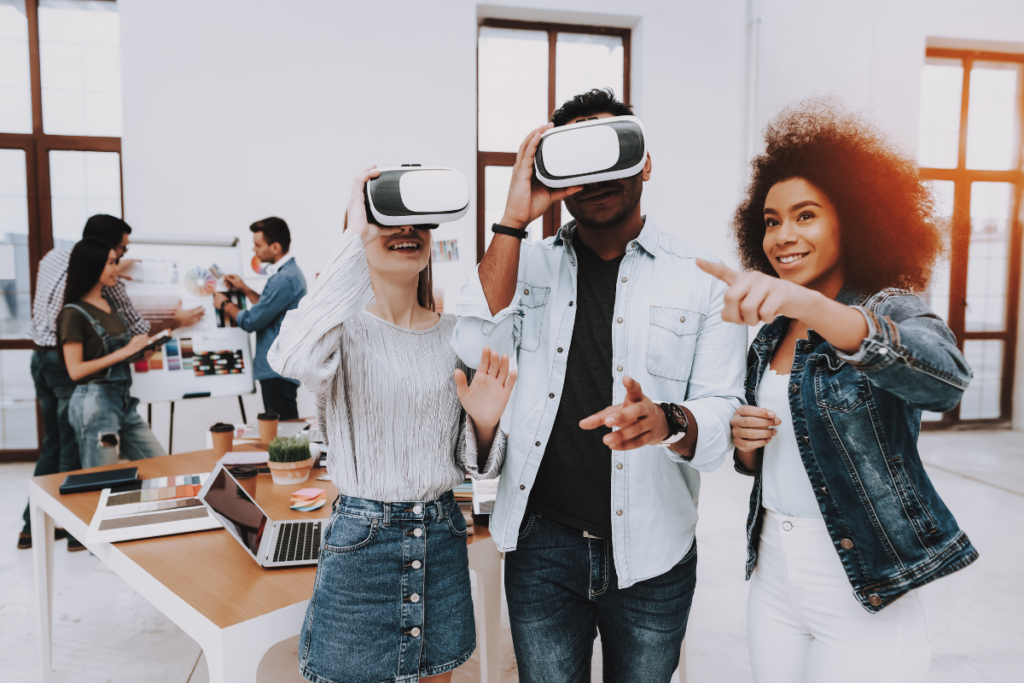
Immersive technology is revolutionizing professional industries through the introduction of new collaboration and training technologies. Healthcare, education and real estate are experiencing enhanced training and customer interaction.
These innovations enable safe simulations and interactive learning that promote problem-solving. But there are greater implications here than increased efficiency. What are the opportunities and challenges in adapting to these immersive solutions?
How Immersive Solutions are Revolutionizing Healthcare
The healthcare industry is experiencing a transformation with immersive technology offering new solutions for patient treatment and training.
Surgery simulations enable surgeons to practice complex operations in a safe setting, and patient simulations offer realistic patient interactions for medical students.
These technologies not only enhance surgical techniques but also encourage a greater understanding of patient interactions, resulting in improved patient care.
Virtual and Augmented Reality in the Classroom
In a quest to engage students in new ways, virtual and augmented reality (VR and AR) is increasingly being integrated into education. Virtual classrooms enhance the learning environment, enabling interactive exploration of challenging topics.
Augmented learning also enhances this learning environment, connecting theoretical learning with real-world experiences, thus promoting deeper learning and critical thinking skills, which are crucial in a rapidly changing world.
Revolutionizing Customer Engagement in Real Estate
Traditionally, customer engagement in real estate has primarily taken place through face-to-face meetings and printed or digital brochures, but the emergence of virtual and augmented reality technologies is set to revolutionise the experience of viewing property listings.
Virtual property tours offer immersive and interactive experiences for clients, allowing them to explore properties virtually. This not only boosts engagement but also gives clients greater flexibility in their property search.
The Future of Work: Adopting Immersive Technology in the Workplace
The accelerating pace of technological change is transforming the way we work, and many industries are adopting immersive technology to boost productivity and collaboration. This facilitates distributed teamwork, enabling teams to collaborate across geographic boundaries.
Moreover, immersive technology is crucial for training, offering immersive experiences that boost employee skills. By adopting these technologies, businesses are enabling a more agile work environment.
Conclusion
To summarise, immersive technology is transforming the professional sectors through collaboration and learning. In a significant statistic, 70% of companies report that virtual reality training is more effective in retaining information than conventional training methods.
This powerful statistic highlights the impact of immersive technology on skills training and client engagement. With ongoing industry adoption of these cutting-edge technologies, there is limitless potential for enhanced productivity and disruptive innovation, promising an exciting future.